
About This Project
NW Cornerstone Meals on Wheels is a community-based organisation providing meal preparation and delivery services to older people, people living alone, people with health or mobility needs, and other service users across the North-West region. The organisation plays an important role in supporting independent living, community wellbeing, and social inclusion.
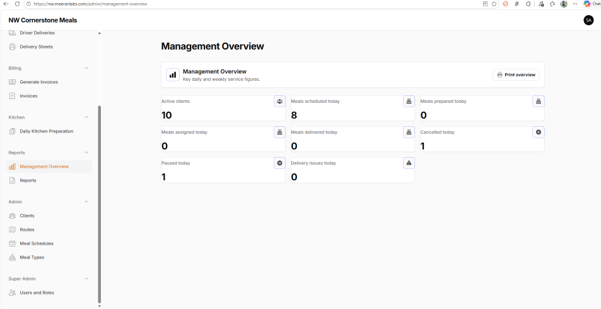
The project was developed following a Design Thinking Workshop. The organisation identified that its existing processes for managing service users, meal preparation, cancellations, delivery routes, subsidies, and invoicing relied heavily on manual communication and disconnected information flows. The key challenge was ensuring that accurate information moved efficiently between administration staff, the kitchen, and delivery operations without duplication or delay. Kitchen staff required a particularly simple solution, while administrative staff needed a faster way to manage services, and drivers required clear printed route sheets. The agreed solution focused on the development of a bespoke Laravel Filament web application designed around the organisation’s existing workflow, prioritising simplicity, role-based access, automated route ordering, and subsidy tracking.
Design Thinking Workshops
12 participants attended the Design Think Workshop at Atlantic Technological University, Sligo. Participants represented different perspectives from within the organisation and drew on their day-to-day experience of managing service users, meal preparation, administration, and delivery routes.
The workshop used empathy mapping, journey mapping, challenge definition, ideation, prioritisation, prototyping, and testing. It successfully identified that the main organisational challenge was the flow of information between administration, kitchen preparation, and delivery operations. The agreed challenge centred on how the organisation could improve communication, coordination, and information management while keeping the digital system simple enough for staff with different levels of digital confidence. The resulting Design Thinking report was approved on 4th June 2026 and formally signed on 18th June 2026.
Deliverables
STRIDE deliverables included:
Bespoke web-based meal service management platform
Centralised service-user records with meal schedule and calendar management
Visual status indicators for active, cancelled, and paused meal services
Simplified kitchen interface featuring a single confirmation checkbox per service user to confirm a meal is prepared and packed
Removal of unnecessary kitchen administration functions
Route assigned directly to each service user upon record creation, removing the need for kitchen staff to assign routes
Automated ordering of printable driver sheets based on delivery routes/runs, including addresses and specific delivery directions
Subsidy confirmation field within the service-user record to support HSE-subsidised meal calculations (e.g., first 5 meals at €6.00, additional meals at €7.00)
Sage reference number integration for accurate invoicing support
Role-based access for different staff functions
Digital handover and system guidance for NW Cornerstone staff
Results & Impact
The project provides NW Cornerstone Meals on Wheels with a practical and user-centred digital system designed around the organisation’s actual working practices. The centralised meal-service management platform dramatically improves communication between administration, kitchen staff, and delivery operations while reducing unnecessary administrative work.
A key outcome of the co-design process was simplifying the kitchen workflow. By presenting kitchen staff with a single confirmation control to indicate that a meal has been prepared, the system lowers the digital barrier to entry. Delivery routes remain consistent because they are assigned when a user is created, allowing the system to automatically generate organised printable driver sheets (without requiring permanent driver assignment, as drivers frequently change).
Furthermore, the project supports robust financial administration through automated subsidy tracking and invoicing functionality. The system automatically calculates eligible HSE-subsidised service users based on agreed charging rules, reducing manual calculation errors. The solution successfully combines digital automation with existing working practices in a way that is realistic, sustainable, and entirely appropriate for a critical community-based service.